




There is a particular meeting that happens in restaurants after a bad month. Somebody brings a number to the kitchen, the number is a percentage, and the sentence attached to it is usually a version of asking everyone to be more careful.
It never works, and attitude has very little to do with it. A percentage is a fact about the business. A cook standing at a section during service is deciding how much sauce goes on this plate, and there is nothing in “we came in at 34” that helps with that.
Why the Target Never Reaches the Line
A food cost percentage is an average across everything you sold in a period. To act on it, you would need to know which dish, which ingredient, which shift and by how much, none of which the percentage contains.
It also arrives weeks late, describing a month the team can no longer remember in any detail. Ask a cook on the fifteenth about a Saturday five weeks earlier and you are asking them to account for something they have no access to.
And it is usually delivered as a problem the kitchen caused. That framing gets you compliance for about a fortnight and then quiet drift, because nobody sustains an effort they cannot see the effect of. The team has no way to tell whether last week went well, so the only signal they ever receive is the next bad month.
What a Cook Actually Needs to Know
What they need is a cash figure for the plate in front of them, on their own section.
The useful unit is what a component costs, not what a dish costs and certainly not what the restaurant runs at. A cook who knows the scallops are 2.80 each will place three instead of four without anyone asking, because now the decision has a number in it. The same cook told the restaurant is at 34 percent has been given nothing to work with.
Take the butter mounted into a sauce. If a cook is generous by fifteen grams a plate, on butter costing 7.60 a kilo, that is eleven cents. Across sixty covers it is about seven euros a service, and over a six-day week it is a bit over forty. Nobody would describe that as waste and by the end of the year it is more than two thousand euros on one habit, on one component, on one dish.
That is the conversation worth having, and it runs on arithmetic anyone can check.
What They Do Not Need
They do not need the food cost percentage. They do not need the P&L, the rent, or the state of the market.
They also do not need the whole dish cost. A dish costs 4.20 and the number is meaningless standing on its own, because a cook has no reference for whether that is good. What has a reference is the two or three expensive components inside it, since those are the things passing through their hands.
Putting the full costing on a spec sheet is a common instinct and it mostly produces a document nobody reads. Putting the price of the three most expensive components on it produces a spec sheet people quote back at each other.
Showing Cost While It Still Matters
The best moment is during prep, not after service and certainly not at a monthly meeting.
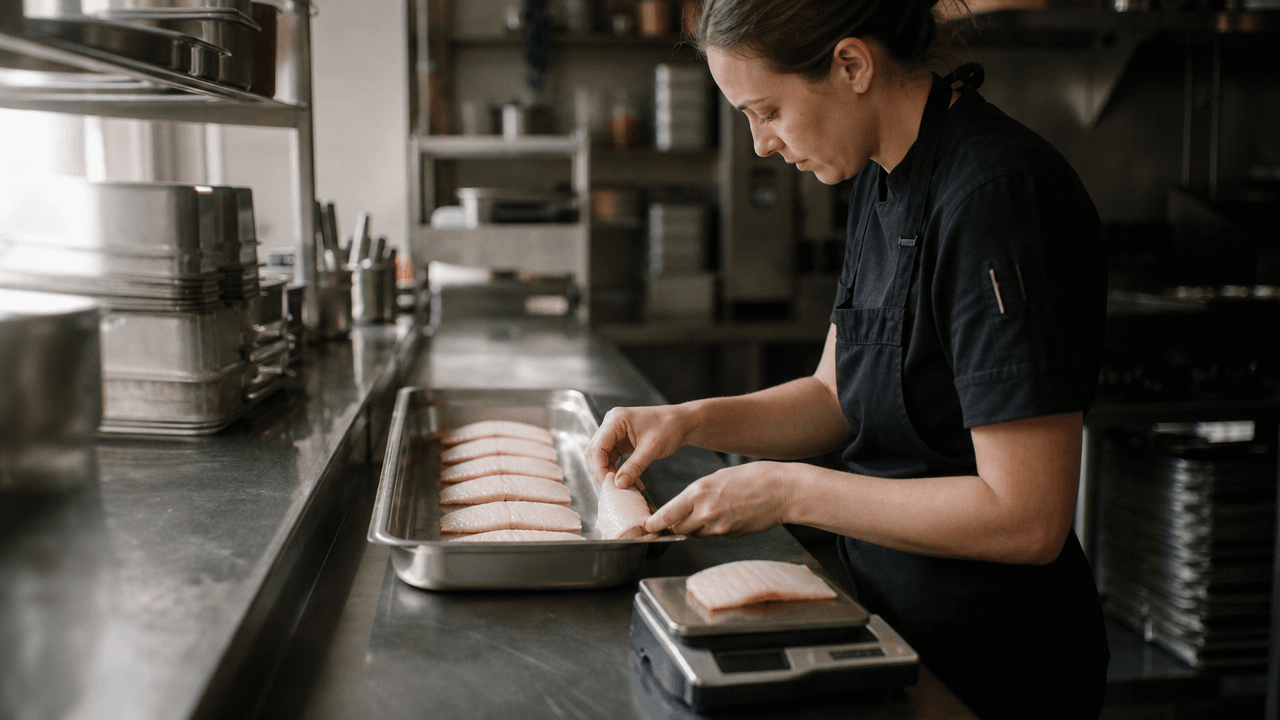
A scale on the bench with the target weight written next to it does more than any amount of instruction, because it converts a judgement into a check. The same is true of portioning tools chosen to match the spec, so that the easy action and the correct action are the same one. Most over-portioning is a measurement problem before it is a discipline problem, which is the whole argument of portion control.
Where a number genuinely helps is on the few lines that carry the money. Price five or six components and put them where the section can see them. Everything else is noise and adding it will bury the part that mattered.
Making the Count Something the Team Owns
The stock count is the one moment the kitchen touches the numbers directly, and in most restaurants it is done to the team instead of by them.
Give each section its own count and its own variance. A cook counting their own fridge and seeing next week that their section is 300 grams light on one line is receiving a fact about their own work, which is a completely different experience from a manager reporting a restaurant-wide figure at a meeting.
That does mean the numbers have to be broken down far enough to be personal, and it means being disciplined about what happens next. A section-level variance used to find a problem builds ownership. The same number used to identify who is at fault ends the whole exercise, because the counts will start being adjusted and you will have destroyed the only reliable signal you had.
The waste log works the same way, and fails the same way, for the same reason.
What Changes When the Numbers Come Back
The part restaurants skip is the return leg. Data goes up from the kitchen and nothing comes back down, so from the team’s point of view they are filling in forms for somebody else’s benefit.
Closing that loop costs very little. A weekly number per section, posted where the section can see it, is enough. So is telling people when a week went well, which is rarer than it should be and does more than most of the corrective conversations put together.
The change to expect is that a cook stops treating the spec as a suggestion, because they have seen what the difference is worth and they have seen somebody notice. That is a much lower bar than getting a kitchen enthusiastic about margin, and it is the one that actually moves the number.
Numbers Small Enough to Belong to Someone
Almost everything above depends on getting the numbers small enough to belong to somebody. Stockifi holds costs at the ingredient level rather than at the dish or the period, so the price of a component can be put on a section where it is useful. Counts done on a phone can be split by storage location, which means variance can be read per fridge and per section instead of per restaurant, and it lands the week after the count rather than a month later. That combination is what turns a food cost conversation from an accusation about a percentage into a specific fact about one line. See how variance analysis works.
Frequently Asked Questions
How do you get kitchen staff to care about food cost? Give them numbers that belong to their own section and are small enough to act on, so the cost of a component instead of a restaurant percentage. Then show them the result of the effort, because a team that never learns whether last week went well has no reason to keep trying.
Should chefs see the food cost percentage? Head chefs and section leads should see it, as context. For cooks on the line it is the wrong unit entirely, since it cannot be acted on at the moment a decision is being made.
How do you train a team on portion control without micromanaging? Make the correct portion the easy one, using scales, the right serving tools and a visible target weight. Measurement removes most of the argument, and what is left is a much shorter conversation.
Does showing staff cost figures cause problems? Only when the figures are used to assign blame. A section-level variance treated as a shared problem to solve builds ownership, and the same number used to identify a culprit will quietly corrupt every count you take afterwards.
The Bar Is Lower Than It Sounds
None of this asks a kitchen to become interested in accounting. It asks for the cost of a handful of components to be visible where the work happens, for the count to belong to the people doing it, and for something to come back down when it does. A team that knows the scallops are 2.80 each behaves differently from a team that has been told the restaurant is at 34 percent. One of them was given a number they could use.